8.5M cans. A store that finally matched the brand.
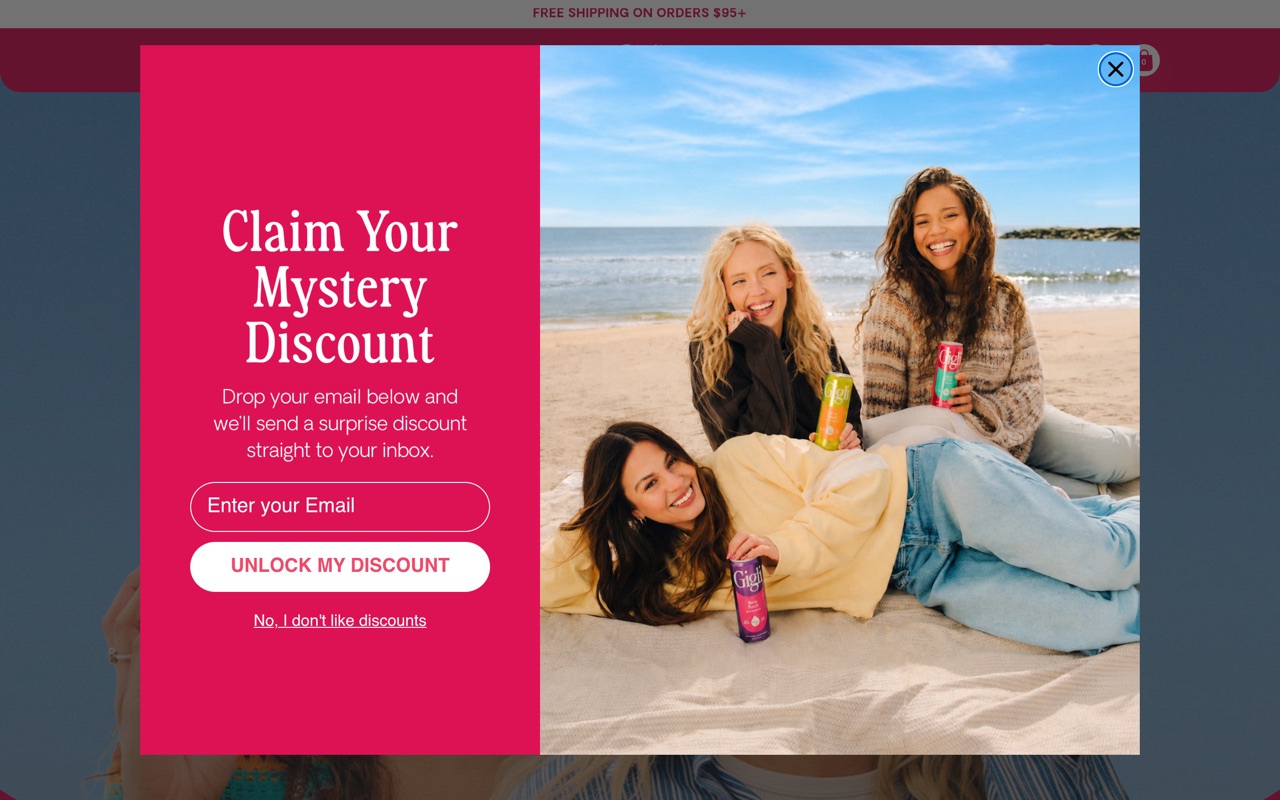
The brand.
Gigli is not a startup finding its footing. With more than 8.5 million cans sold, they are a proven product in a category that barely existed five years ago: hemp-derived THC beverages positioned as a premium, hangover-free alternative to alcohol. The proposition is clear and it resonates — a sessionable drink that gives you the social looseness of a cocktail without the next-morning cost.
The flavors are the product. Gigli built its following on the sensory experience of drinking something that genuinely tastes good — not medicinal, not earthy, not the compromise most early hemp products required. That flavor-first identity is the brand. It lives in the can design, the color language, the way the product is photographed. It is not incidental to the business; it is the business.
Which makes it all the more striking that their online store — the primary channel for direct-to-consumer sales — was doing none of that work.
The problem.
Gigli was running on a generic Shopify theme. Not a bad theme — generic in the most literal sense: built to sell anything to anyone, optimised for no one in particular. It had product grids, collection pages, a cart. It functioned. But it communicated nothing about who Gigli is, what the drink feels like to hold, or why you should choose it over a cold beer on a Friday afternoon.
The mismatch between product and storefront was doing real damage. A visitor who arrived from a social ad — drawn in by Gigli's visually confident creative — landed on a page that looked like every other Shopify store they had ever seen. The contrast did not just disappoint; it actively undermined the premium positioning the brand had spent years and tens of millions of cans building.
In DTC e-commerce, the storefront is not a neutral vessel. It is part of the product experience. When a visitor lands on your product page, they are not just evaluating the item in the image — they are evaluating whether this is a brand worth trusting, worth paying a premium for, worth returning to. A generic theme answers all of those questions with a shrug. Gigli's product deserved better than a shrug.
At 8.5M+ cans sold, Gigli had earned the right to a storefront that felt like theirs. A generic Shopify theme is a missed opportunity at every price point — but it is most costly when the brand itself is the primary reason someone is paying a premium.
What we built.
The brief was a bespoke DTC storefront built around Gigli's flavor-first identity. Not a template with custom colors dropped in, not a lightly reskinned Dawn — a ground-up Shopify theme designed to make the can the hero of every page, and to make every interaction feel like it belongs to this brand and no other.
The product page was the highest-priority surface. In DTC beverage e-commerce, the product page is where conviction is built or lost. A visitor who arrives interested but unconvinced needs to leave that page ready to add to cart — and the gap between a generic template and a purpose-built experience is where that decision is made. We designed the Gigli product page to lead with the flavor, carry the brand energy throughout, and remove every friction point between intent and purchase.
Performance was a non-negotiable constraint, not a secondary consideration. A beautifully designed page that loads slowly is not beautiful — it is invisible, because the visitor has already left. The sub-2s product page load is the result of decisions made at every layer: image formats, resource loading order, critical CSS, and a Liquid template architecture that does not ask the browser to do unnecessary work.
The custom cart experience was a deliberate choice. Most Shopify stores lose their visual identity the moment a visitor opens the cart drawer — the default Shopify styles reassert themselves and the brand evaporates. We held Gigli's visual language through the cart and into the checkout, because the moment of purchase is not a moment to look like everyone else.
What we did not do.
We did not change the brand. Gigli's visual identity — the colors, the can design, the flavor-forward photography — is the result of deliberate creative decisions by a team that understood exactly what they were building. Our job was to give that identity a storefront that could actually express it, not to second-guess it.
We did not recommend a platform migration. Shopify is the right platform for a DTC beverage brand at Gigli's scale — it handles inventory, compliance, subscriptions, and integrations without friction. The problem was never the platform. It was the theme sitting on top of it. Replacing the theme costs a fraction of a migration and delivers the result faster.
We did not pad the scope. A custom Shopify theme is a specific deliverable with a clear definition of done. We built what was needed, held the performance bar we committed to, and did not propose additional workstreams as a way of extending the engagement.
The result.
The new storefront loads product pages in under two seconds. That is not a minor improvement in the context of DTC e-commerce — it is the difference between a session that converts and a session that bounces. On mobile, where the majority of beverage DTC traffic arrives, page speed is a direct input to add-to-cart rate. Gigli's product pages are now fast enough that speed is no longer a variable in the conversion equation.
Conversion rate improved. The mechanism is not complicated: when a product page is visually distinctive, on-brand, and loads fast, more of the visitors who arrive with intent follow through to purchase. The Gigli storefront now does the brand-building work that a generic theme was failing to do — and that work shows up in the numbers.
The brand mismatch is gone. A visitor who arrives from a Gigli social ad now lands on a page that extends the creative energy they were drawn to, rather than contradicting it. The storefront and the brand are finally telling the same story. For a product that sells on sensory experience and premium positioning, coherence between creative and commerce is not a nice-to-have — it is a revenue driver.
The result is what a bespoke storefront should deliver: a digital presence that earns the same trust and desire that the physical product has built over 8.5 million cans.
A custom Shopify theme is not a luxury for brands that have "made it." It is a lever available to any brand that has earned a strong visual identity and is losing ground by housing it in a generic container. For Gigli, the case was clear — and so was the outcome.
What this means for your store.
If your brand has a strong visual identity — one that lives in your packaging, your social creative, your photography — and your Shopify theme is a generic starting point you never fully escaped, you are leaving a meaningful gap between what your brand promises and what your store delivers. That gap costs you on every visit.
The fix is not a platform migration. It is not a full brand refresh. It is a storefront that was built to express your brand rather than to accommodate it. A custom Shopify theme is a scoped, deliverable engagement — not an open-ended project — and the impact shows up in conversion rate, brand trust, and the coherence of the experience you offer from first ad impression to purchase confirmation.
DTC e-commerce at scale is won or lost on the product page. If your product page looks like a template, it is competing on price. If it looks like your brand, it is competing on identity — and identity is a more durable advantage than any discount you could run.
Your store should feel like your brand.
Tell us what platform you're on and what the gap is between your brand creative and your current storefront. We'll tell you what a bespoke build looks like and what it would take to close it.